How to read a Safety Data Sheet for a cleaning product
An SDS has 16 sections in a fixed order. What each one tells a buyer and a worker, and where to find the sheet for every Baja Supply formula.
A Safety Data Sheet (SDS) has 16 numbered sections, always in the same order. Sections 1, 2, 4, 7 and 8 answer what a crew needs first: what it is, what can go wrong, what to do. Baja Supply publishes one SDS for each formula, with every revision, at baja.supply/sds.
What an SDS is
An SDS is the technical sheet that travels with a hazardous chemical. Under OSHA's Hazard Communication Standard, the company that makes or imports the chemical prepares it. Distributors and employers receive it with their first shipment, and again with the first shipment after the sheet is updated.
The format is fixed. The SDS must be in English and use 16 numbered headings in a set order, so a reader who knows one sheet can find the same answer on any other. Employers may keep copies in other languages as well.
At work, the standard asks employers to keep the SDS for each hazardous chemical where employees can reach it during every shift. Paper or electronic copies both work, as long as nothing gets in the way of immediate access. The standard also lists exceptions, among them some consumer products used the way, and as often as, a consumer would use them. An employer who relies on an exception has to be able to show that it applies.
The 16 sections at a glance
| Section | The question it answers | On Baja Supply's sheets |
|---|---|---|
| 1. Identification | What is it, who is responsible, whom do I call? | Product, varieties covered, the US importer, Poison Help 1-800-222-1222 (24 hours) and 1-800-670-5003 (business hours) |
| 2. Hazard(s) identification | What can it do to people? | Serious eye damage, Category 1; signal word Danger; corrosion pictogram |
| 3. Composition | What is in it? | Each ingredient with its CAS number and a range in % by weight |
| 4. First-aid measures | What do I do after contact? | Eyes: rinse with water for at least 15 minutes, eyelids open, then medical attention right away |
| 5. Fire-fighting measures | What if there is a fire? | Not flammable (water-based) |
| 6. Accidental release measures | How do I clean up a spill? | Spills make floors slippery; absorb large spills, rinse small ones |
| 7. Handling and storage | How do I store it? | Closed, upright, cool and dry, out of the sun; never mixed with other chemicals |
| 8. Exposure controls/personal protection | What should workers wear? | Splash goggles or safety glasses with side shields when pouring or handling bulk containers; rubber or nitrile gloves for long contact |
| 9. Physical and chemical properties | What is it like? | pH as supplied: laundry 7.5–8.0, softener 3.5–4.0, dish soap 6.5–8.5 |
| 10. Stability and reactivity | What must it be kept away from? | Strong oxidizers, strong acids, other chemicals |
| 11. Toxicological information | How can it cause harm? | Through the eyes, the skin or swallowing; the eye class is based on composition |
| 12–15. Ecological, disposal, transport, regulatory | What other rules apply? | Not regulated by DOT for transport; the California Proposition 65 warning; the ingredient disclosure at baja.supply/ingredients |
| 16. Other information | Is this the latest version? | Revision number and date, and what changed |
OSHA does not enforce sections 12 to 15, because other agencies regulate that information. They are still part of the standard format.
What a buyer should read first
Section 1 tells you whether the sheet matches the product you bought and who stands behind it. Our sheets name every variety they cover, by name and SKU, because all the varieties of a line share one base formula and differ only in fragrance and colorant. OSHA allows one sheet for a group of similar mixtures like these.
Section 2 is the hazard summary. For all three Baja Supply formulas it reads the same: serious eye damage, Category 1, with the signal word Danger and the corrosion pictogram. The hazard statement is "Causes serious eye damage."
Section 16 gives the revision and its date. When a sheet is revised, the earlier revision stays on our Safety Data Sheets page, so you can check which one was current when an order arrived.
What a worker should read before opening a pail
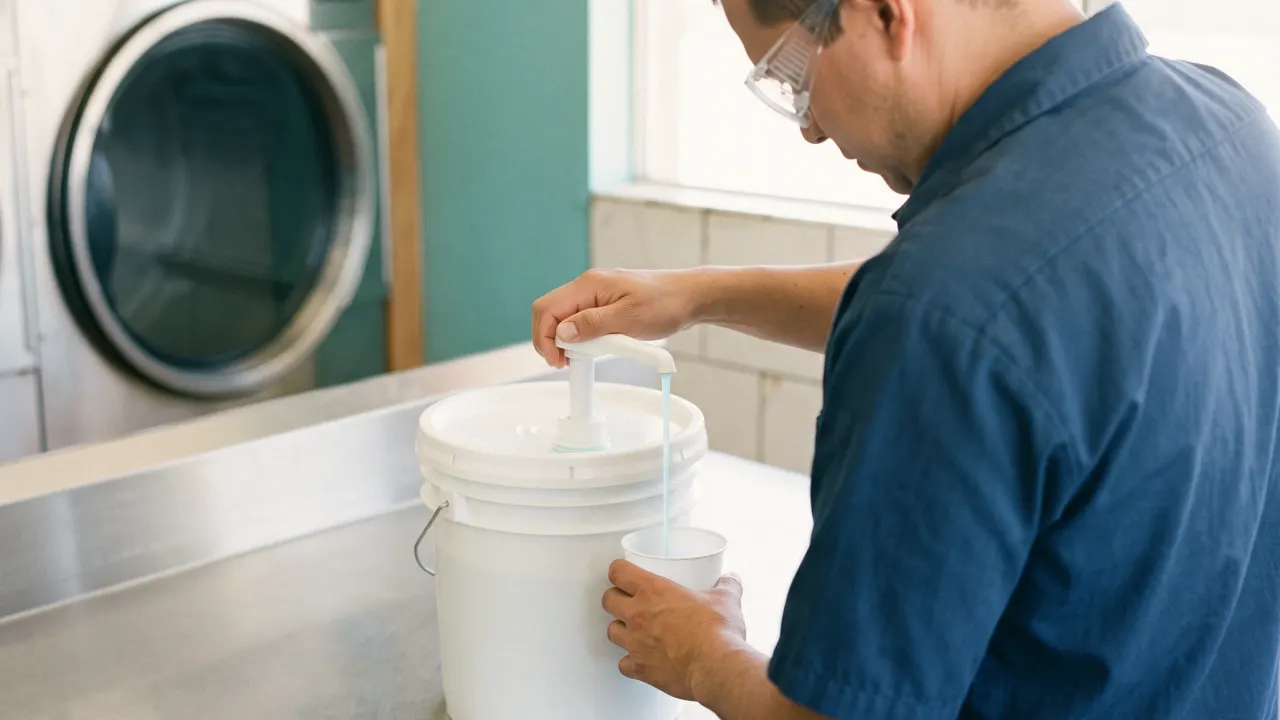
Section 8 says what to wear. On our sheets, that means eye protection when pouring or handling the pails, and gloves for long contact or bulk handling.
Section 4 says what to do if product gets in the eyes, on the skin or is swallowed. For the eyes: rinse right away with water for at least 15 minutes, holding the eyelids open, remove contact lenses, and get medical attention.
Sections 6 and 7 cover spills and storage. Keep pails closed and upright, away from sun and heat, and never mix the products with other chemicals.
Where to find Baja Supply's sheets
All three are on the Safety Data Sheets page: liquid laundry detergent (PAPALOTE™), fabric softener (SIESTA™) and liquid dish soap (CAZUELA™). Each product page and each ingredient page links to its sheet, and the lot lookup links the sheet for the formula of each lot. The sheets are in English.
Questions
Is there a different SDS for each scent?
No. Each line has one formula, and its SDS covers every variety of that line. Section 1 lists them.
Why is the SDS only in English?
OSHA requires the SDS to be in English. Employers may keep copies in other languages too.
Whom do I call in an emergency?
Sections 1 and 4 give Poison Help, 1-800-222-1222, open 24 hours for medical questions. For questions about the product, call Baja Supply at 1-800-670-5003 during business hours.
Sources
- Occupational Safety and Health Administration (OSHA), Hazard Communication, 29 CFR 1910.1200, paragraphs (b)(6)(ix), (g)(1), (g)(2), (g)(4), (g)(6) and (g)(8). Read 2026-11-05 [verified]. https://www.osha.gov/laws-regs/regulations/standardnumber/1910/1910.1200
- OSHA, Appendix D to 29 CFR 1910.1200, Safety Data Sheets (Mandatory). Read 2026-11-05 [verified]. https://www.osha.gov/laws-regs/regulations/standardnumber/1910/1910.1200AppD
- OSHA, QuickCard: Hazard Communication Safety Data Sheets (OSHA 3493, 2024). Read 2026-11-05 [verified]. https://www.osha.gov/sites/default/files/publications/OSHA3493QuickCardSafetyDataSheet.pdf
- Baja Supply, Safety Data Sheets page and the SDS for the liquid laundry detergent, fabric softener and liquid dish soap, sections 1 to 16. Read 2026-11-05 [verified]. https://baja.supply/sds
- Baja Supply, Frequently asked questions: Ingredients and safety. Read 2026-11-05 [verified]. https://baja.supply/faq